Kangshung Face
The ClimbThe Kangshung Face, Everest’s eastern face, is more than a geographic reference in the account of the 1996 storm: it marks the difference between a survivable error and a fall into a deadly void. During the blizzard on the South Col, climbers searching for Camp IV lose their orientation and come perilously close to the face. Its edge becomes a point of danger for the disoriented group, a wrong turn in Anatoli Boukreev’s rescue attempts, and, the following year, the place where he finds and covers Yasuko Namba’s body.
Terrain and danger
Before the storm, Neal Beidleman had studied the terrain and decided that, if visibility collapsed, the group should avoid both the Lhotse Face and the precipice. He intended to steer the climbers across a slight side slope toward the South Col saddle, then use a distinct band of rock as a landmark: from there, turning right and descending among the rocks should lead toward Camp IV or its surrounding debris. The plan was meant to keep the group away from exposed steep terrain while offering a recognizable route through poor visibility.
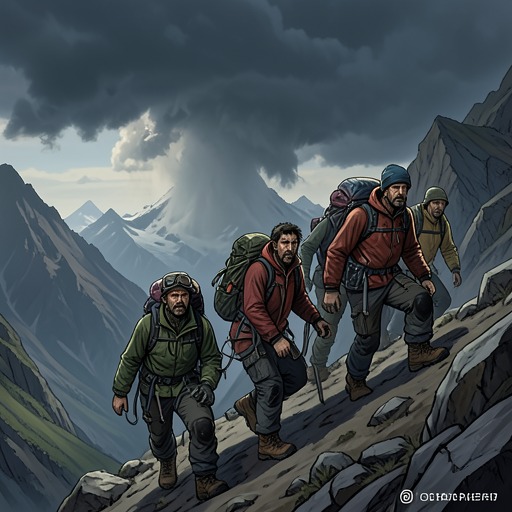
The storm disrupted that strategy. Wind buffeted the climbers and pushed them back and forth; they moved by following whichever headlamp was in front, without a settled leader or a common direction. Beidleman was helping guide the group while supporting Yasuko Namba, and could not get to the front. The climbers side-hilled too far, lost the slope that had provided their reference, and eventually wandered onto the Tibetan side of the South Col. With Beidleman’s oxygen exhausted and the others staggering, the surrounding terrain became difficult to interpret. The face was not simply a distant hazard: the group’s own movement was carrying them toward it.
The lost group at the edge
After perhaps an hour of wandering, Beidleman saw a dip in the ice and rock ahead. The headlamp revealed difficult ground with rock protruding through the ice, but the rise beyond the dip offered no familiar feature of the South Col. He approached its edge, recognized that the terrain was dangerously wrong, and returned to the others. With Tim Madsen and Klev Schoening’s help, he urged everyone to stay together and called for them to huddle and wait for a break in the storm that might reveal stars or the surrounding mountains.
The climbers formed a “dogpile,” turning their backs to the wind and lying against one another. They beat on each other’s backs, checked fingers and consciousness, and tried to keep one another warm and awake. When the snow briefly eased, Beidleman could make out stars; on another opening he called out the Big Dipper and the North Star. Someone identified Everest, but even then the group could not confidently tell whether the mountain before them was Everest or Lhotse. Their brief glimpses of the sky offered hope without restoring dependable orientation.
The account places the huddled group less than twenty meters from the Kangshung Face and about four hundred meters from Camp IV. In clear conditions, they might have reached camp in ten to fifteen minutes. Instead, the blizzard left them lost at the edge of the face, close to shelter but unable to find the route. The distance makes the episode especially stark: the camp was nearby in geographical terms, yet the storm had made that proximity useless.
Boukreev’s searches
At Camp IV, Boukreev tried to find the missing climbers. On an early search he crossed the South Col in strong wind and near-zero visibility, without crampons, following what he understood to be the direction described to him. He reached a large rock and recognized that a route beyond it descended toward the Kangshung Face. Unable to see anyone and unable to climb farther on the steep ground without crampons, he returned to camp. In retrospect, the direction had taken him toward the mountain rather than to the group; the face’s terrain made a mistaken approach dangerous as well as fruitless.
Boukreev made another attempt after returning to camp and speaking with Martin Adams. Later, after Neal Beidleman, Klev Schoening, Lene Gammelgaard, and others reached Camp IV, he learned that Sandy Hill Pittman, Charlotte Fox, and Tim Madsen still needed help. He set out again in severe wind and blowing snow. On the route, he came close to the place where the dogpile had been but could not see the group. He also lacked crampons on that attempt, and turned back rather than negotiate steep ground without them. The mountain’s concealed contours repeatedly narrowed what a rescuer could safely do: directions supplied in camp did not guarantee that the route could be recognized in the storm.
A landmark in the aftermath
During his final attempt to reach Scott Fischer, Boukreev again encountered the Kangshung Face in darkness and near-total whiteout. At roughly 8,200 meters, the storm intensified and visibility fell to only a few meters. He recognized that he was near the face, changed direction, and then found discarded oxygen bottles and tents. Beck Weathers’s screams helped guide him toward the Mountain Madness tents, where he collapsed from exhaustion. In this episode, the face is part of the disorienting landscape through which even an experienced climber could lose his way; finding the camp depended on fragments of terrain and sound rather than a visible route.
On the following year’s return to Everest, Boukreev crossed the South Col to the edge near the Kangshung Face, where he had left Namba during the storm. He found her partially covered by snow and ice. Her pack was gone, and its contents lay scattered among the rocks and ice. He gathered small belongings for her family, moved stones to cover her body, and left two ice axes as markers. The location that had threatened the lost climbers now held the remains of one of them, and Boukreev’s careful acts of remembrance gave the dangerous landscape a human meaning beyond navigation or survival.